KEY HIGHLIGHTS
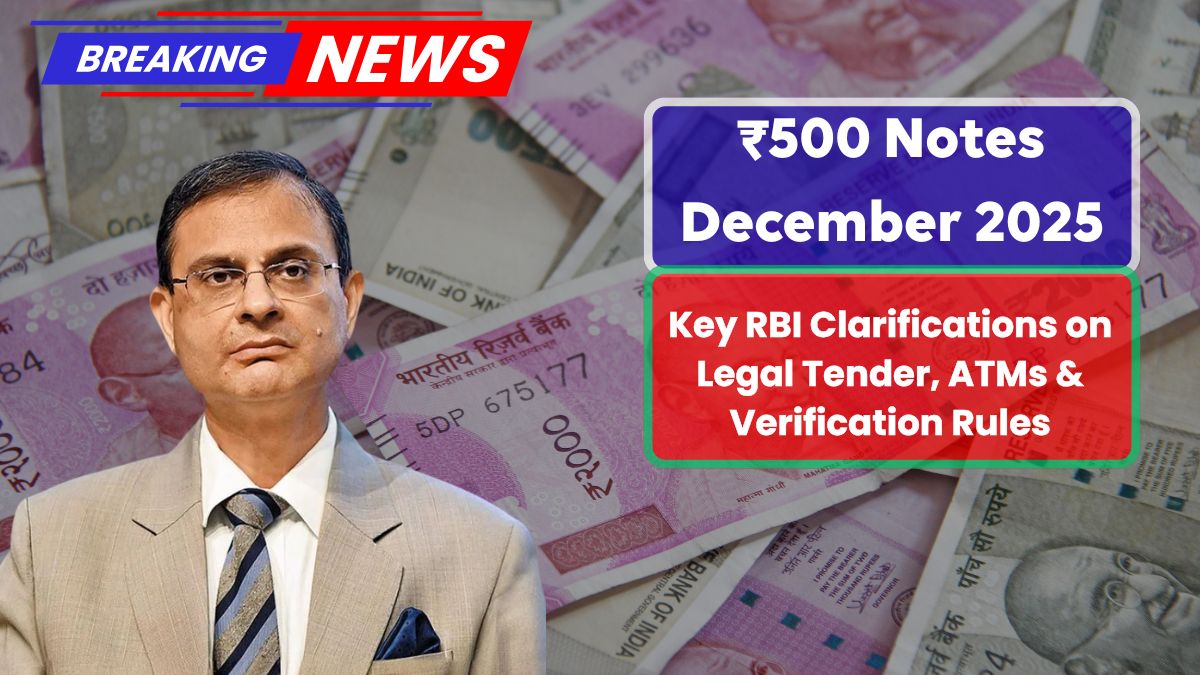
- RBI confirms ₹500 notes remain full legal tender in December 2025.
- New verification rules apply only to bulk deposits, not public use.
- No ban, no deadline—₹500 stays valid and continues in ATMs.
If you’ve opened WhatsApp anytime this month, you’ve probably seen at least one scary forward saying “₹500 note band ho jayega!” And honestly, it rattled a lot of people — especially shopkeepers, seniors, and anyone handling cash daily.
Let’s break it down with the asli sach: RBI has clearly stated that ₹500 notes remain 100% legal tender. There’s no recall, no demonetisation, nothing.
Quick Comparison: Rumour vs Reality
| Topic | Rumour Going Viral | RBI’s Actual Position |
|---|---|---|
| Validity of ₹500 notes | Will stop after Sept 2025 | Fully valid, no deadline |
| ATM circulation | ₹500 removed from ATMs | ₹500 continues as per demand |
| New rules | ₹500 discontinued | Only verification rules updated |
| Fake note risk | “New design coming” | No design change announced |
The panic started because earlier this year RBI told banks to increase ₹100 and ₹200 notes in ATMs.
That simple guideline turned into a wild rumour:
“₹500 notes will stop working after September.”
Total fiction.
 Join WhatsApp
Why the Rumours Started — And Why RBI Had to Step In
Back in April 2025, RBI asked banks to ensure more small notes in ATMs so people could get change easily.
Somehow this became a twisted WhatsApp version about withdrawing ₹500 notes.
By December, RBI had to issue a crisp clarification:
“₹500 notes remain valid. Period.”

That’s it. End of story.
What Actually Changed: New ₹500 Verification Rules (Dec 2025)
There is one update — but it’s for safety, not banning notes.
From December 2025:
- Banks must use high-end machines to verify bulk deposits in ₹500 notes.
- These machines detect tiny flaws: ink issues, watermark mismatches, micro-text errors.
So if your big cash deposit takes a little longer, relax.
It’s just upgraded scanning — not suspicion.
This matters a lot for markets, petrol pumps, mandis, and wholesale traders where fake notes can quietly circulate.

And once again:
Genuine ₹500 notes are absolutely safe to use.
ATM Rule Update: Why You’ll See More ₹100 & ₹200 Notes
RBI has also set new targets for ATM cash mix:
- 75% of ATMs must dispense ₹100 or ₹200 notes by Sept 2025
- 90% by March 2026
Now here’s the important point — this does NOT reduce the presence of ₹500 in ATMs.
Banks will still load ₹500 based on demand.
The goal is simply to avoid those awkward moments when you’re buying a ₹10 chai with a ₹500 note and the vendor glares at you.
How to Quickly Check a Real ₹500 Note
If rumours are floating, fake notes also tend to increase.
Here’s a simple 3-step method:

- Tilt it — numeral shifts from green to blue
- Light it — windowed security thread shows “Bharat” and “500”
- Touch it — raised printing should be clearly felt
These features remain unchanged in 2025.
Ignore anyone saying a “new design” is coming.
What to Do With Torn or Damaged ₹500 Notes
RBI rules make this super clear:
- Any bank branch will exchange damaged ₹500 notes
- No upper limit for genuine exchanges
- Only the old 2016 demonetised ₹500 series are invalid
- Current notes stay valid indefinitely
If you get a suspected fake note, hand it to the bank.
No penalty for reporting — you’re doing the right thing.
December 2025 RBI Snapshot: All Key Points in One Place
- ₹500 remains full legal tender
- ATMs will increase ₹100 and ₹200 output, but ₹500 stays
- Bulk deposits will now undergo advanced verification
- Security features remain the same
- Damaged note exchange is allowed freely
Everything else? Just noise.
Smart Tips for Staying Safe With Cash in 2025
- Always do a quick tilt-light-touch check
- Prefer UPI for high-value payments
- Avoid taking badly torn notes late at night
- Only trust RBI/PIB updates
- Keep your banking apps updated
Panic spreads fast.
Facts don’t.
Choose facts.

The Larger Truth: Cash Still Rules Many Households
Digital payments may be growing, but for millions of Indians, cash is still king.
RBI’s message in December 2025 was simple:
Strengthen verification, improve ATM mix, protect confidence — and keep ₹500 stable in circulation.