KEY HIGHLIGHTS
- Singapore commits S$37 billion to RIE2030 for the next five years.
- Over S$3 billion goes to new semiconductor and active ageing research programmes.
- Move strengthens economic resilience and boosts long-term innovation capacity.
Singapore just dropped one of its biggest research announcements in years.
If you’ve been feeling the impact of rising costs or wondering how Singapore will stay competitive from Jurong East to Pasir Ris, this new RIE2030 plan gives us a clearer picture of where the country is heading.
The government has committed S$37 billion over the next five years to boost science, technology and innovation. That’s a massive step up from the previous plan, and it shows how seriously Singapore is taking issues like the semiconductor race and our rapidly ageing population.
Before we dive into the full breakdown, here’s a quick glance at what’s inside.
 Join WhatsApp
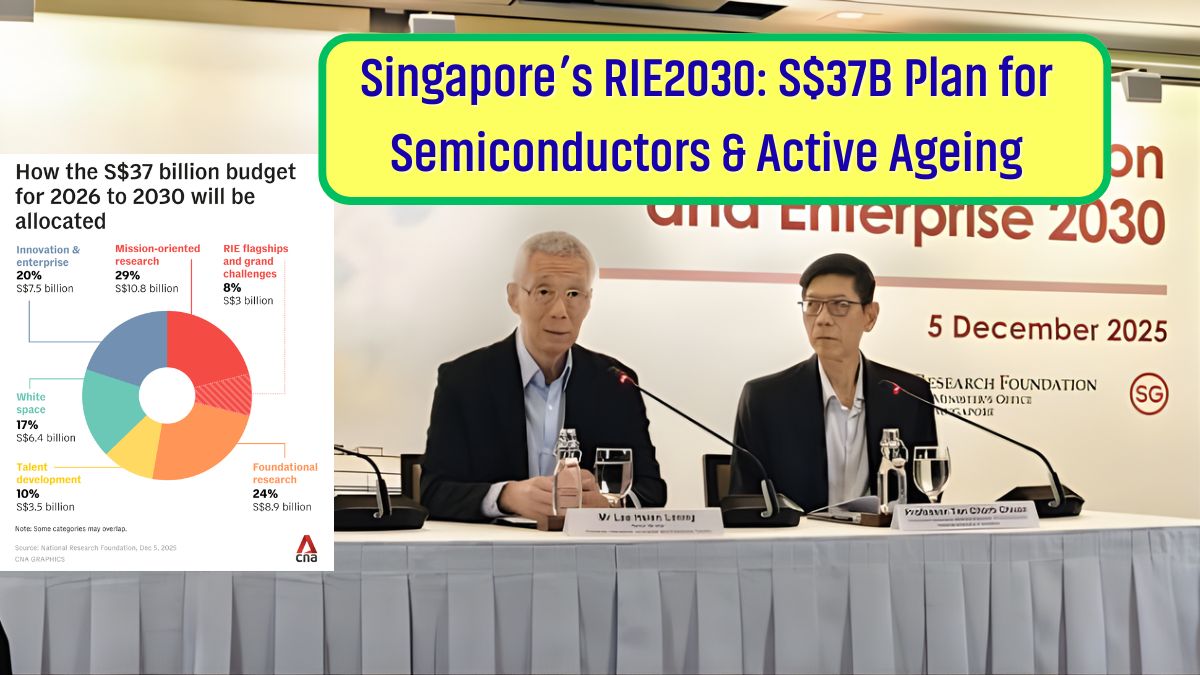
RIE2030 Budget Overview (Quick Table)
| Category / Programme | Share of Budget | What It Focuses On |
|---|---|---|
| Four Key Domains | S$10.8B (29%) | Manufacturing, health, sustainability, digital economy |
| Foundational Research | 24% | Long-term science and discovery |
| Innovation & Enterprise | 20% | Research translation and startups |
| White Space & Infrastructure | 17% | New programmes, facilities |
| Talent Development | 10% | Local and global research talent |
| New Flagship & Grand Challenge | S$3B | Semiconductors + Active Ageing |
A Bigger Push: 32% More Funding Than RIE2025
RIE2030 isn’t just a continuation of the old plan. It’s a 32% increase in funding and takes a sharper turn towards sectors that will define Singapore’s future.
The four major domains—manufacturing, human health, urban solutions and smart nation—will now manage their own innovation pipelines.
This means ideas can move from lab to real-world trials faster, something many local SMEs and MNC partners have been asking for.

Leaders also highlighted that even with global tensions, multinational firms have not pulled back from Singapore’s R&D landscape. In fact, demand for collaboration has grown because of our stable environment and strong engineering talent.
Semiconductors Take Centre Stage
One of the two major new programmes under RIE2030 is the Semiconductor Flagship.
Singapore wants to cement its role as a “key node” in the global supply chain—especially now that chips are seen as a security priority worldwide.
The programme will:
- Build advanced capabilities in packaging, photonics and integration
- Tighten R&D alignment with industry demands
- Grow home-grown tech companies
- Strengthen the engineering talent pipeline
Global semiconductor revenue is expected to hit S$1 trillion to S$1.3 trillion within the next five years, mainly due to AI chips and memory technologies.
Singapore is positioning itself to ride that wave, especially after securing over S$18 billion in semiconductor investments in the last two years.
The Grand Challenge: Ageing & Long-Term Health
The second major programme tackles something closer to home—active ageing.

By 2030, one in four Singaporeans will be 65 or older.
We’re living longer, but the last decade of life is often where frailty and chronic conditions sink in.
The new Ageing Grand Challenge aims to:
- Understand long-term trends in Singapore’s senior population
- Study biological, genetic and lifestyle factors that drive decline
- Test new healthy-ageing solutions quickly
- Turn research into preventive practices for everyday life
Think of it as building a national health engine—one that helps us stay mentally sharp and physically active for longer.
Where the Rest of the Funding Goes
The remaining RIE2030 funds continue to support the four main domains, each playing a crucial role in Singapore’s economic resilience and daily life.
Manufacturing, Trade & Connectivity
Expect investments in:

- Next-gen semiconductors
- Supply chain technologies
- Robotics and automation
- AI systems
- Future fields like the space economy and bioeconomy
Human Health & Potential
This includes:
- Precision medicine
- Biomanufacturing
- Disease prevention research
- Childhood cognitive development
- Skills-learning studies across age groups
Urban Solutions & Sustainability
Key areas include:
- Climate resilience
- Low-carbon technologies
- Building Centres of Excellence
- Real-world deployment of climate solutions
Smart Nation & Digital Economy
Singapore will strengthen capabilities in:
- AI and digital trust
- Quantum tech
- Cybersecurity applications
- Cross-sector digital deployment
- Talent training and partnerships
Do We Have Enough Talent?
According to officials, Singapore’s research talent base is strong and competitive.
But as programmes scale up, the demand grows beyond scientists.
Large projects need:

- Engineers
- Data specialists
- Technologists
- Lab and field experts
The RIE2030 plan places heavy emphasis on nurturing young local talent while also attracting global expertise.
How Success Will Be Measured
Unlike start-ups, research isn’t judged only by commercial returns.
Many breakthroughs take years to mature.
Instead, Singapore will assess:
- Long-term scientific impact
- Contributions to global knowledge
- Value created for everyday life
- Industry adoption over time